Sunday, 17 February 2013

Jennifer's Body: Opening Sequence Analysis!

The first existing movie opening sequence I decided to analyse for inspiration was Jennifer’s Body (2009, directed by ). This film was clearly created with my target audience of young females in mind with a plot that focuses entirely around a group of young people against the back drop of a high school. As well as dealing with supernatural issues, the teens struggle with stereotypical troubles faced by youths of today e.g. boyfriend dramas and competing with a beautiful and popular best friend. The film is rated '15' and therefore can be viewed by my target audience of 16-24 year olds.


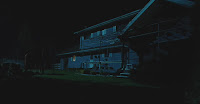
Ominous music (non-diegetic sound) helps to create tension. The scene is shot at night as an example of pathetic fallacy. Darkness is used to create an atmosphere of evil and fear (bad things often happen at night). A sense of the unknown is created. Pathetic fallacy would be a useful technique to use for my own production, however, filming at night would be difficult without the required equipment. Therefore, in order to create a sombre mood I would have to use a cloudy or rainy day or, perhaps, darken my shots using effects during postproduction. The scene begins with an establishing long shot of a stereotypical American home. The camera slowly travels towards the building as a tire swing blows eerily in the breeze. The idea of inanimate objects, such as park swings, moving by themselves is a common convention of the horror genre.

  
The sans-serif typography used for credits is distressed, another typical convention of horror movies and something to remember when carefully selecting my own typography.


As we move into the home, the audience are presented with an uncomfortable big close up of a teen scratching at her arm. Something about a close up centering on one body part disorientates an audience; diegetic sound of the scratching is slightly gruesome. 


This technique is also used in the Darren Aronofsky psychological thriller, Black Swan. Nina, the main character, is often seen scratching and peeling off skin around her nails, drawing blood. This is graphic and gruesome, difficult for an audience to watch. Blood and gore was brought up a couple of times as an important feature during my research interviews.


Suddenly the non-diegetic music is almost reminiscent of nursery rhymes. Children in horror movies are often portrayed as evil (e.g. Orphan which was mentioned in my target audience research) and toys such as old glass dolls are often causes of fear.
A cutaway takes the audience back outside of the house. The shot zooming forwards begins to appear like a POV (point of view shot) and there is a sudden sense that someone is approaching the teens window. 


Here, the sans-serif typography of the movie title fades in. The pink, overly girly text challenges the genre conventions. The audience would expect to see red, distressed text but instead are presented with typography more stereotypical of a rom-com. This is further evidence that the target audience for this movie is young girls. Rom-com is perhaps a sub-genre of this movie.


 Another cutaway moves the audience back into the teenagers pink (connoting femininity, cuteness and glamour) room. The mise-en-scene demonstrates verisimiltude, the setting depicting exactly what we would expect a typical teens bedroom to look like. Lying lazily on her bed, watching TV she seems to be a relatable character. Viewers may relate to her through personal identification (uses and gratifications audience theory) and see themselves reflected in the text. Including young characters, dressed in modern day costume, was something also highlighting as important in my research. 

The camera looms over the girl at a high angle, making her appear small and vulnerable. Slow straight cuts help to build the tension. 


A sudden jump scare shocks the audience as a face appears at her window. This is accompanied with a sudden load piece of non-diegetic music. As the teenage girl is facing away from her window, unaware of this new presence, dramatic irony is created.

 
 A sound bridge aids the transition from the bedroom into a mental hospital. A soft and identifiable teenage voice provides the non-diegetic voice over, “ Hell is a teenage girl”, again anchoring the target audience. Inside the mental asylum the camera tilts downwards, the music dark and off-key. In mise-en-scene we see crosses (a suggested prop from target audience interviews) and other religious items on the floor. Religion, particularly Catholicism, frequently features in horror movies because of it’s links to demonic possession (e.g. The Exorcism of Emily Rose and The Rite). 

The mise-en-scene is typical of a mental asylum cell. A blonde teen sits alone in a room, the bars on her window emphasising the feeling of captivity. The voice over provides an introduction to what the film will be about. The words, “nobody comes back”, paired with a close up shot of a picture frame suggests that death will be a theme in this movie, an obvious convention of the horror genre. 

The audience begin to realise that this voice over is in fact an epilogue to the movie, setting up what the events will lead to before revealing them. Wearing the stereotypical orange prison uniform, the blonde teen moves (with under cranking) through the grey and run down building. Her non diegetic voice over is chatty and relatable. The audience may be confused at first as to why this girl, who could be any of their friends, is actually a prisoner here.  However,  the tone suddenly changes and her true character is revealed. 

A dutch tilt (or canted angle) is used to create a feeling of imbalance. The straight cuts increase in pace to reflect the girls sudden mental breakdown. 

A graphic close up shot of  blood on the floor makes the audience uneasy. This sequence provides the action and fast pace my targeted audience asked for during the interviews.


 In the darkness of her cell, the girl curls up , the shadows of the bars reflecting onto her face emphasising, once again, how she is alone, trapped and isolated. 

The opening sequence ends with the non-diegetic voice over words “I used to be normal”. This opening has clearly set up the narrative and given the audience a clue as to just what the film will be about. The next hour and a half will be spent revealing the events that lead up to the young teen entering prison. I like the idea of a film beginning at the end. This has a similar effect to the beginning of the movie ‘Sinister’ mentioned during the interviews. ‘Becky’ told me how that movie began with an immediate death scene, without explanation. The audience had to watch on in order for this to be resolved. Furthermore, as suggested during my interviews, not too much information is revealed about character.

I was particularly inspired by the gruesome images, canted angles and POV shots, relatable characters and the narrative of this opening sequence. I am looking forward to analysing a few more movie openings before beginning to outline my own movie proposal!

Friday, 15 February 2013

Target Audience Interviews!


Here is a compilation of the best responses from interviews with my desired target audience. Watching this back, I learned that most young people do enjoy to watch horror movies.


Usually this is once or twice a month. Halloween time is obviously more popular for films of this genre: one female teen 
admitted to watching eight films around this season!


 I also realised that most choose to watch horror movies in a group or at the cinema. Audience reactions (e.g. screaming at jump scares) seem to add to the enjoyment of the horror movie. The Women in Black, Orphan and Sinister were popular choices for favourite horror movies amongst these young people.


 I plan to analyse a few of these movies for inspiration and look at the opening sequences in detail. From the descriptions given by the young people I gathered that most included some sort of death scene. However, some seemed to open simply setting the scene and giving the audience a glimpse of life pre-terror. This fits in with Todorov's narrative theory which suggests that all storylines begin with equilibrium, suddenly disrupted by some event. The balance is returned to at the end of the narrative. However, the newly established equilibrium differs from the initial calm. 


I feel that my opening sequence should begin with my characters going through their everyday routines, however, the cliffhanger concluding my piece will act as the destruction to the peace. Perhaps, a death could work as an end to the equilibrium. Most 16-18 year olds interviewed stated that they would prefer a fast paced opening to the movie with gripping action and a death scene to immediately draw them in. Music (non-diegetic sound) and dull (low key) lighting were also highlighted as a key device in tension building. 


My audience also seem to expect fast paced editing to keep the opening gripping and entertaining. For sound effects my audience seem to think either strings or piano music or, on the other hand, complete silence (this creates a lot of unease and anticipation for the audience) then disrupted by a sudden scream. Both techniques could be effective in making a piece that conforms to conventions of the horror genre. Another interesting idea raised was making every day noises sound sinister. For example, in The Women in Black the sound of a tap dripping creates a jump scare. That way, even after the movie, the viewers are haunted by the film when they hear these sounds in their own home. Interestingly, most of the young people expected a modern, realistic mise-en-scene. They seemed to believe that characters should be dressed in a way that is 'normal' and familiar in order for the piece to be believable (creating verisimilitude).


One teen did suggest dark clothing which I do feel is appropriate (black connotes death and fear), therefore, I will incorporate a dark colour scheme into my mise-en-scene to establish a negative atmosphere. The same teen suggested using an object that is supposed to be frightening; this inspires me to perhaps center my storyline around an object possessed.
  Nearly all of the people interviewed seemed to believe that they could relate most to a 'damsel in distress-like' character (Propp's character theory). I must therefore include a young and relatively average teen as the main protagonist in my film. This evokes further fear in an audience who start to believe the horrific events could actually happen to them, seeing their own personalities reflected in the victims. 

  
In response to my final question it seems that most people believe that characters should be introduced before the horrific events begin. The audience must be given chance to get to know and connect with the victims rather than the antagonists (perhaps the evil character should be of a different age group or wear abnormal clothing in order for them to be impossible to relate to).


Overall I feel that this has been a very helpful piece of research. I am now looking forward to looking at some popular horror movie openings in order to gain inspiration and begin storyboarding.

Tuesday, 12 February 2013

Focus group questions!


Just arrived back from my trip to Los Angeles! 


After spending so much time in Hollywood I am more inspired than ever for this chance to act as a filmmaker for A Level coursework. I have been considering many ideas for my film and am so excited to finally get to work. In order to do so, I have already begun completing further research. I plan to ask my selected target audience a set of questions. I'll interview a mix of genders but mainly those between the ages of sixteen and eighteen to receive the most useful comments possible. I plan to record the answers on camcorder and edit together a montage of the best responses. I feel this is more useful to me than survey results; this is because, on camera, I can expect to hear more detailed and specific responses from my audience and avoid the bias that multiple choice can sometimes encourage.

I have compiled a list of eleven questions:

1. What is your opinion of horror movies? 
2. How often do you watch horror movies?
    3. What was the last horror movie you saw and when did you see it?
    4. What would you expect to see in a horror movie opening in order to keep you watching?
   5. Name your favourite horror film and state why it is your favourite.
   6. What can you remember about the opening sequence to that movie?
   7. What features do you think I should include to create atmosphere and tension in my opening?
8. What kind of music and sound effects would you expect to hear? 
    9. What costumes and props would you expect to see?
   10. What kind of characters would you be able to relate to most and enjoy watching?
    11. How would you expect these characters to be introduced to an audience on screen?


 I aim to interview students from my own college (Winstanley College) as these people slot into the appropriate age group. Once I have filmed them answering these questions I can put together a video of the responses! 

Tuesday, 5 February 2013

Survey Responses!

Over the past few days I have received 48 responses to my survey! I am so glad that I now have such an insight into my target audience.

In order to encourage mainly young females to answer the questions I posted a link on my personal Facebook and Twitter accounts asking my friends to complete the survey. 


I then posted a video asking my 455 YouTube viewers (mainly young females) to complete the survey. 


After analysing my results I can't say I found anything too surprising. Most responses were predictable. I am pleased to say that 40 out of the 48 who answered the survey were actually female and 35 of these are within my desired target age group of 16-24. Now, this could seen be as negative and a creation of bias, however, if I wish for this to be my movies target audience then I must pay close attention to what that audience desire to see. Filling in an anonymous survey, my audience are also more likely to give honest answers.


The results of question three were particularly pleasing to me. I found that the comedy and horror genres were the most popular with 30 votes each. This clearly proves that horror is a genre popular with a younger, teenage audience. I myself am not particularly interested in the comedy genre but I accept that it is equally as popular amongst young females. I now definitely intend to create a movie opening of the horror genre for my coursework.


Least favourite film genres inspired a less clear response. Each category seems to be equally disliked by a few. However, historical clearly came top with 22 people stating their dislike for it. This may influence me to stay away from a horror movie opening set during another period (for example, as in 'The Others' or 'The Women in Black') and focus on present day; a time which is much easier for young people to relate to.


Question five, asking how often the audience actually view horror movies, also created quite a positive response. Only 3 people claimed to never watch horror movies. Most- exactly 18 or 37.5%- claimed to watch horror films once every month. This is pretty frequent again expressing just how much my target audience clearly enjoy this genre.


Question six made it very clear that characters and acting are highly important to my audience. These are the faces they will be forced to stare at on screen for an hour and a half. I think I need to be extra careful when deciding who should perform each role in my own film. I obviously want talented actors who will be able to portray the emotion of fear. I also want an actor to be able to perform a convincing death scene. I think for a young audience it is also important to use actors of a similar age group to themselves to create a connection. Attractive people are also ideal.  A beautiful actress attracts a male audience who see her as a sex object but also a female audience who view the female as someone they can relate to and see themselves reflected in (uses and gratifications audience theory- personal identification).

Looking at sub-genres only 1 person actually said Gothic was their favourite! Just 8.3% chose Slasher and 10.4% chose Documentary. Supernatural and Psychological thriller were the clear winners. I will bare these two most popular sub-genres in mind when creating my own horror movie opening as they are clearly enjoyed most by my target audience.


The next few questions allowed the audience free expression of their own personal opinions. They were asked to fill in text boxes explaining what they like and dislike about the horror genre in general. Common responses for positives were interesting storylines, sudden plot twists, the suspense, jump scares, watching with friends, likeable characters and a sense of dramatic irony (e.g. in Alfred Hitchcock movies the audience often know what the characters do not). 


 Many people clearly dislike the bad acting in many horror movies as well as predictable, unrealistic and boring storylines. I must take care to make my project creative and unpredictable, ending my opening on a cliffhanger. Again, it is highly important that I choose the best actors possible in order to make my film appealing. 


Popular answers for favourite horror movies were Orphan, The Others, Let Me In, Black Swan, Psycho and The Women in Black. I will remember these titles to look at for inspiration in the near future. Reasons for these being chosen as favourites were mainly due to having a more complex storyline that keeps the audience thinking. Clearly my target audience are out for something deeper than a scare.


 I have definitely decided to target my movie towards young people leaning slightly towards the female audience too. I think I must complete more research into this target audience. I plan to interview a few members of the 16-18 age group in order to collect some more information before I actually begin my planning! I will work on this from Monday the 11th after I have returned from a trip to Los Angeles.


Saturday, 2 February 2013

Survey Monkey!

I have just completed a set of ten questions for my research survey on Survey Monkey! I am hoping that this research will give me more of an insight into what my target audience would expect to see in a horror movie opening. In order to get my desired audience to answer these questions I will post the survey on Twitter, Facebook and YouTube (as we know teenagers are the main users of social networking sites). My filmmaking YouTube channel (MeganOlivierFilms) is also mainly viewed by females. Therefore, if I advertise my survey here I am more likely to get my desired audience answering my questions and providing me with relevant feedback.
The first two questions I have chosen to ask are pretty obvious. I want to know each person’s gender and age. Therefore, if more people of one particular gender or age group answer my questions I can keep this in mind in order to prevent any bias.

  Next, I asked for people to give there favourite and least favourite film genres. Already, I am pretty sure that I would like to make a horror movie and I know from my own experience (I am a teenager after all!) that most young people do love horror movies. However, I need to be sure of this and provide some evidence to back up my claims. If I find, while analysing responses, that more people enjoy comedy movies than I will have to rethink either my target audience or genre for my film opening.


Furthermore, to be sure that my target audience truly are fans of horror movies I asked them to specify how often they would choose to watch them. This question is also important as the questions to follow all centre around features and conventions of horror. Opinions of people who do not watch horror movies often will not be as credible because they will have less knowledge of the genre.


With my next question I asked the audience to consider which element (script, acting, editing, camerawork and sound) is most important in a horror movie. Of course all of these elements are important in producing a successful and professional film opening. However, it will be interesting to see which the audience feel I should spend the most time on and which is therefore most memorable to the general public. 

 
The next question is highly important. I asked for people to specify their favourite sub-genre of horror. I am unsure of which sub-genre I will choose for my film, therefore, this feedback could be high influential in helping me decide which sub-genre to create my film under.

The next question allows freedom in response. People are required to filled in a text box and state their favourite thing about horror movies. Again, responses to this question will be highly influential. Furthermore, the text box prevents bias because people have no choice but to give their own honest opinion.
Similarly, I then asked for people’s least favourite thing about horror movies. I need to be sure to avoid original as possible. 

Finally I asked for everyone to state their favourite horror movie. This will be helpful to me when structuring my own narrative but also when decided which films openings to view for inspiration.

Now I will give a few days to allow for an adequate amount of responses to analyse. I will then take a look at my findings in detail. Hopefully the responses I receive will give me enough insight to know where I should go next with my research and perhaps even planning.

Friday, 1 February 2013

Prelim Criticism!


I was happy to see that I received 15 comments on my Media Studies prelim film, posted on YouTube, over the past two days. These are even more useful to me as most of my viewers slot into my potential target audience (young females around the ages 16-24 years). The criticism I received was incredibly helpful and encouraging. I now feel more confident than ever about producing this film.

The feedback was mixed. Many people felt that I had used a good variety of camera angles, which is something I would of course emulate in my final piece. However, six viewers suggested that over the shoulder shots would have been a nice addition (I will remember this for my film opening) and that perhaps my close up shots should have been at shoulder level rather than being so close to the face. However, I am a huge fan of close up shots and shallow depth of field so I may continue to do this in my final film.


Another issue that was highlighted by three viewers was a distracting image in the background of my two shot. This is something I should be more careful about when shooting my final film. All irrelevant scenery should not be part of the mise-en-scene. At the time I felt the chosen setting was not relevant enough. The mise-en-scene of a college is not in keeping with the narrative of a job interview. An office and more professional attire would have been more suitable.


A couple of viewers felt the audio was easy to understand and complimented the flow. However, four viewers felt that the actress on the right needed to slow down the delivery of her lines. The girl has a strong Wigan accent that was difficult for my audience (made up of mostly USA females) to understand. Furthermore, it is clear that both girls did not know their lines and were reading from a piece of paper. 


As highlighted in the image above, two viewers felt lighting was an area that needed to be improved upon. However, another two viewers felt that lighting was a positive aspect of the film. In order to make sure my lighting it perfect for the final film I will be sensible about which times of day I choose to shoot (e.g. I will not shoot at night). I may also choose to use my studio lighting. 
Most people were impressed with the editing and continuity, which was the main goal of this task. A final criticism I received from just one viewer was the suggestion of using a tripod throughout, as early shots are unstable. I will keep this in mind when shooting my two-minute film opening and only use handheld shots for suspense. 
I feel like I have learnt a lot from this prelim task. The feedback from my target audience has given me a lot to consider. To further my research, I now plan on creating a survey on the site 'Survey Monkey' to receive further feedback, centred around the horror genre, from my target audience.